When Latin Stops Being Latin: Can AI Translate a Language That Does Not Quite Exist?
What happens when the language you are translating does not quite exist?
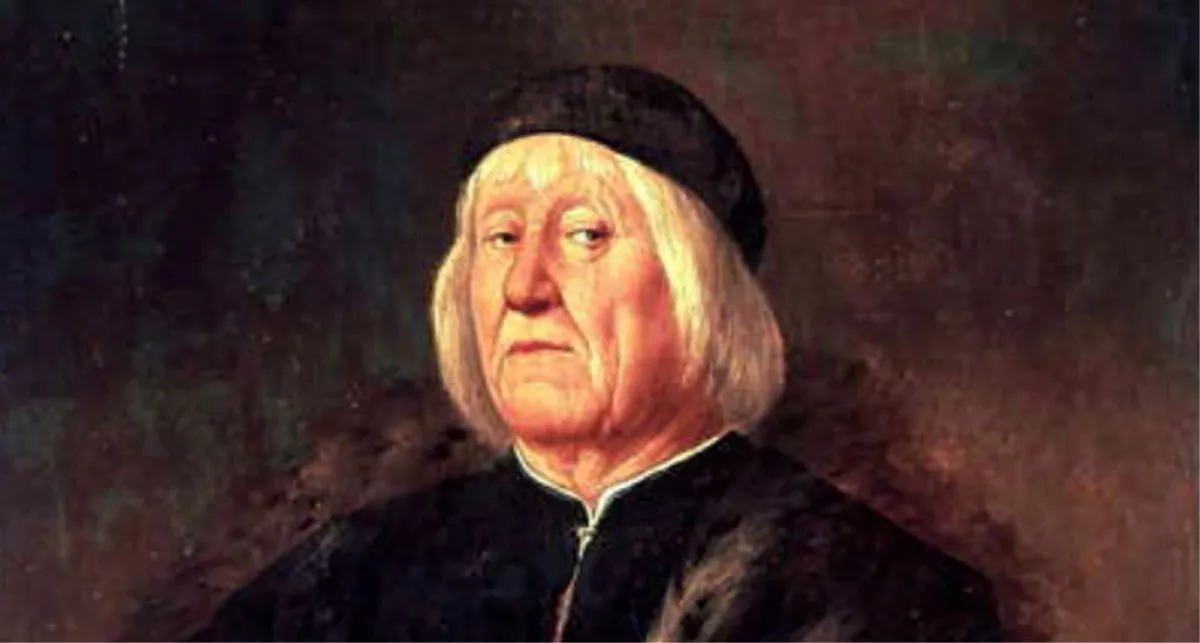
Teofilo Folengo’s macaronic verse looks like Latin, behaves partly like Latin, and poses a revealing challenge for AI-assisted literary translation.
We decided to find out.
For this experiment, we gave TranswrAIte a passage by Teofilo Folengo (1491–1544), the extraordinary Renaissance poet better known under his literary persona Merlin Cocai (Merlinus Cocaius).
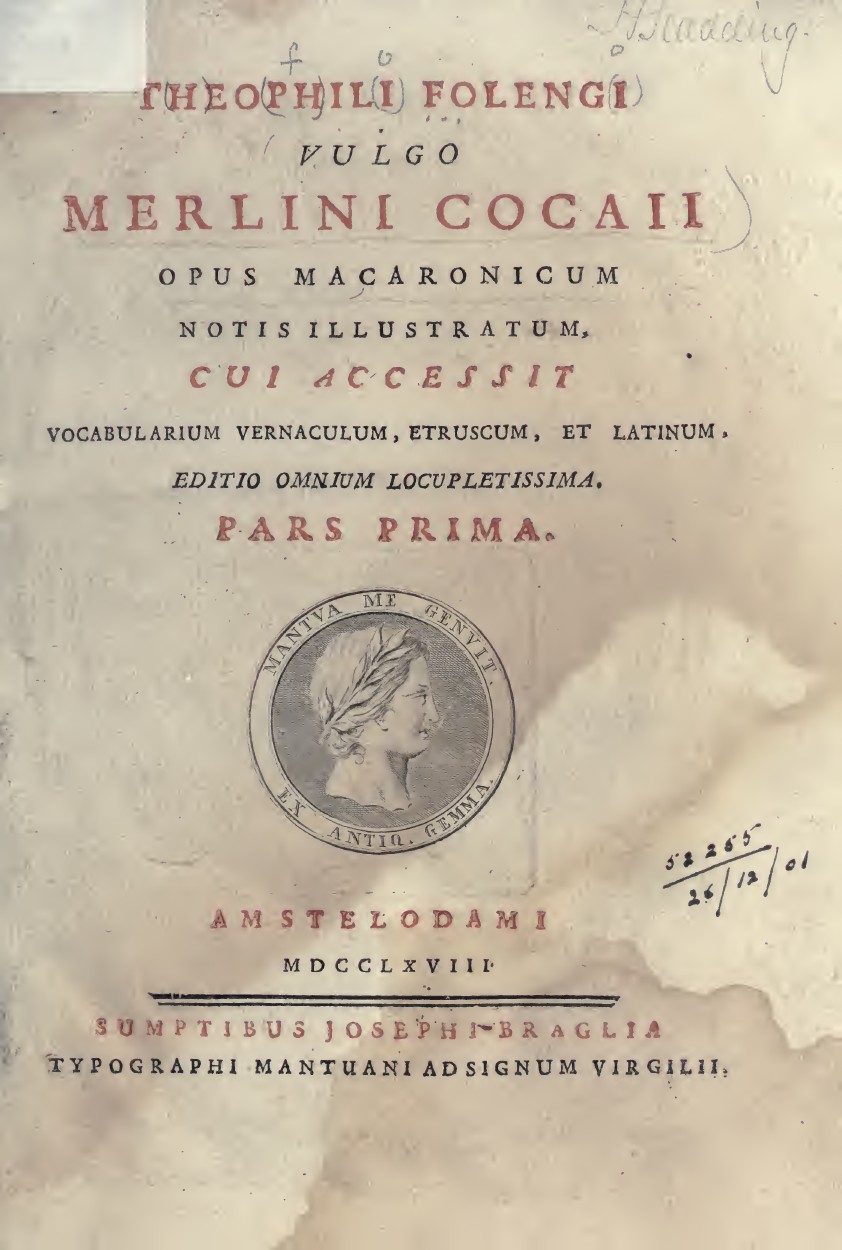
Folengo is one of the great practitioners of macaronic literature, a deliberately hybrid form of writing in which Latin grammar and literary conventions collide with vernacular Italian, Mantuan dialect, popular expressions, invented words, and the vocabulary of everyday rural life. The result looks like Latin. It behaves partly like Latin. But try translating it and things become considerably less comfortable.
The passage comes from the Zanitonella, more fully Zanitonella sive inamoramentum Zaninae et Tonelli, Folengo's comic-rustic account of the peasant Tonello's love for Zanina. It appears alongside the much larger Baldus, Folengo's celebrated mock-heroic epic, in his collection of macaronic works.
Its opening immediately gives the translator a problem:
Forte caleffabit gens me citadina vilanum,
quod sic Zanninae brusor amore meae,
quod ve, bovum stallas usus nettare boazzis,
sforzor amorosas fora butare doias.
Words such as
citadina, vilanum, brusor, boazzis, sforzor, mangiare...
inhabit a linguistic borderland. Italian and dialect words are pushed into Latin syntax, dressed in Latin endings, or simply allowed to wander into the sentence wearing their muddy boots.
The joke is not merely in what Tonello says: the language itself is the joke!
First experiment: translate the meaning
We began with the conventional task: make the passage readable in English prose while preserving its meaning.
The result was:
Perhaps the city folk will mock me as a country bumpkin because I burn so fiercely with love for my Zannina, because, accustomed as I am to cattle stalls and the nectar of cowherds, I struggle to pour out my pangs of love. Alas, sooner or later we are all caught in love's birdlime: whoever does not love when young, believe me, will love when old. Nor are those who drive well-fed oxen to water, who milk cows, shear sheep with their shears, feed donkeys on grass and goats on leaves, lead lean pigs to acorns, and know how to gather grains of wheat from the woods any less maddened by love than city people are. No one on earth seems able to eat his bread without having his belly pierced by love's sharp needle. Whether a man is a peasant or was born in the city, Cupid eventually drags everyone into his trap. That rascal shoots his darts this way and that, flying like a blackbird, blind and without breeches. And although the pen with which I write is as much a spade to me, and the familiar hoe has hardened my hands with calluses, and although my inkwell is a great rustic barrel from which I drink while beautiful Zannina drinks away my brains, still, alas, I have not been able to escape this terrible burning, through which the spade is finally forced to yield to the pipe.
Something interesting has happened.
The meaning is there. Tonello expects sophisticated townspeople to laugh at a peasant attempting love poetry. He responds that love is hardly an urban privilege. Cowherds, shepherds, pig keepers and farmers become just as ridiculous under Cupid's influence as everyone else.
But Folengo has disappeared, or, more precisely, one important part of Folengo has disappeared. In other words: the English is too well behaved.
Folengo's original depends on collision. Elevated literary Latin crashes into cowsheds, hoes, pigs, goats, breeches and calloused hands. Vernacular words are forced into Latin grammatical machinery. Sometimes they fit, sometimes they bulge spectacularly from the sides but the truth is that a clean semantic translation solves precisely the problem Folengo wanted to create.
So we tried again.
Second experiment: translate what the language is doing
Instead of asking TranswrAIte to reproduce only the meaning of the passage, we asked it to reproduce its linguistic behaviour.
Here was the prompt:
"Translate the following passage by Teofilo Folengo into English, but do not normalize its macaronic language. Recreate in English the comic linguistic friction of Folengo's original: keep Latin syntax, inflections, or Latin-looking forms where they remain intelligible, while mixing them with ordinary English, rustic vocabulary, and deliberately anglicized or hybrid Latin-English words. Where Folengo creates pseudo-Latin forms from Italian or dialect words, invent analogous pseudo-Latin forms from English words when possible. Preserve the rural, bodily, comic register of the original. The result should feel as though a Renaissance peasant who knows just enough Latin to misuse it magnificently were trying to write elevated English love poetry. Prioritize the linguistic effect of the original over grammatical correctness, but keep the passage sufficiently intelligible that an English reader can reconstruct its meaning. Do not turn it into modern slang or parody medieval English. The goal is not “bad English,” but macaronic English: English wearing an oversized Latin toga."
And this time we got something considerably stranger:
Perchance the citadine gens will calefact me for a villanus, because thus for my Zannina I burnor amorously, and because, accustomed to the stallas of oxen and the nectar of cowmen, I sforz myself to buttare forth these amorous dolours. Alas, once at least are we all vesciated in the birdlime of Amor: he who loveth not as a puttus, credite me, shall love as a vecchius. Nor less mattified than urban gentes are those who menate the pastured oxen to beverate, who mung the vaccas, who with forfices tosate the sheep, who pasture asinos upon grass and capras upon fronds, who know how to ducere lean porcos unto the acorns, and who know how from the busches to cavate the grains of wheat. Nemo upon terra seemeth able to mangiate his bread whose panza is not perforated by the puntigerous needle. Be he a contadinus, be he natus in urbe, once into his trapola Cupido trahit every man. He tirates his veretones hither, the improbus tirates them thither, flying like a smerlus, caecus and without bragas. And although this penna wherewith I scribo be unto me a badilus, and the celebrated zappa giveth callous hands, and although my calamar of ink be a great botazzus, from which I sugo whilst bella Zannina sugat my cerebrum, nevertheless, oyme, I could not scampare that grievous brusor, through which the vanga is sforzata at last to cedere unto the piva.
Now the English has a problem, which is precisely the point.
Calefact. Burnor. Vesciated. Mattified. Beverate. Tirates. Puntigerous. Sforzata.
They are linguistic monsters! Some are Latin, some are English pushed toward Latin, some are Italian left deliberately visible. Others are hybrids that belong comfortably to neither language.
And suddenly the English reader encounters something closer to the difficulty experienced by Folengo's original reader.
Meaning is not enough
This tiny experiment exposes a larger problem in literary translation.
Translation is often imagined as movement between two stable points:
Language A → Language B
But literature is rarely that cooperative: what happens when Language A is already unstable?
A text may be multilingual, dialectal, archaic, syntactically distorted, phonetically written, deliberately ungrammatical, or constructed from several linguistic registers simultaneously. A writer may misspell a word because a character mispronounces it. Another may import the syntax of one language into another. Another may invent words whose meaning comes partly from the fact that they should not exist.
In such cases, correcting the language while translating it can mean destroying information.
The first translation of Folengo tells us what Tonello says; but the second attempts to tell us something about what Folengo is doing.
These translations answer different questions.
That distinction becomes especially important with AI-assisted literary translation. A language model is extraordinarily good at normalization. Give it damaged grammar, unusual syntax or hybrid vocabulary and its instinct is often to infer the intended meaning and produce fluent target-language prose.
Usually, that is useful, but with guys as Folengo, it can be catastrophic.
The ugliness, contamination and grammatical violence are not defects waiting to be repaired: they are literary devices.
Wrap up!
Instead of treating the model as a machine for producing a single definitive translation, we can use it to explore a space of possible translations: one semantic, another rhythmic, another syntactic, another historical, another deliberately foreignizing.
The human translator can then decide which losses matter, just because every translation loses something.
Folengo makes that unusually visible. Translate him into polished English and we preserve Tonello's argument while sacrificing much of the comedy encoded in the language. Push the English itself into macaronic territory and we recover some of that instability, but at the cost of lexical precision and historical authenticity.
There is no magic prompt that eliminates the trade-off.
That is one of the ideas behind TranswrAIte: not to make literary translation automatic, but to make its alternatives visible.
Five centuries before large language models, Merlin Cocai was already stress-testing the idea of translation.
Rather inconveniently for us, he was doing it with cows.
Field Notes · by TranswrAIte