The Poetry Turing Test Is Over
The Day ChatGPT Beat Shakespeare (And Why That's Not the Story)
Readers preferred AI-generated poems to canonical poetry—but the most revealing result may be what the experiment tells us about reading itself.
Every few months, a paper about artificial intelligence appears that promises to settle one of the great cultural anxieties of our time. This one seemed particularly definitive. Its title alone was enough to provoke equal measures of excitement and despair: AI-generated poetry is indistinguishable from human-written poetry and is rated more favorably. If you only read that headline, it would be easy to conclude that poetry, after surviving centuries of wars, dictatorships, market crashes and literary manifestos, had finally been defeated by a chatbot.
Fortunately, like many good papers, this one becomes far more interesting the moment you move beyond the headline.
What the researchers actually discovered is not simply that people struggle to distinguish poems written by ChatGPT from poems written by Shakespeare, Emily Dickinson or Sylvia Plath. The truly fascinating finding is that many readers systematically mistake the qualities that make AI-generated poetry immediately enjoyable for the qualities that make great poetry enduring. The experiment therefore tells us at least as much about the way we read as it does about the way language models write, and that makes it surprisingly relevant for anyone working on literary translation.
The experimental design was almost disarmingly simple. The researchers selected fifty poems by ten well-known English-language poets spanning several centuries, from Chaucer to Dorothea Lasky, and then asked ChatGPT 3.5 to generate poems “in the style of” each of those authors. Importantly, they resisted every temptation to improve the outputs: they did not refine the prompts, regenerate unsatisfying results or ask humans to select the best examples. The first generations produced by the model became the dataset.
More than sixteen hundred participants were then presented with a mixture of authentic and AI-generated poems and asked a deceptively straightforward question: which ones had been written by humans?
Their performance was not merely mediocre. It was statistically worse than chance.
Participants correctly identified the author only 46.6% of the time, and even more remarkably, they were consistently more likely to identify the AI-generated poems as human than the poems actually written by famous poets. In other words, the machine was not simply convincing enough to pass as human; it often appeared more human than the humans themselves.
At this point, the story already feels slightly unsettling. But the second experiment is where things become genuinely difficult to interpret.
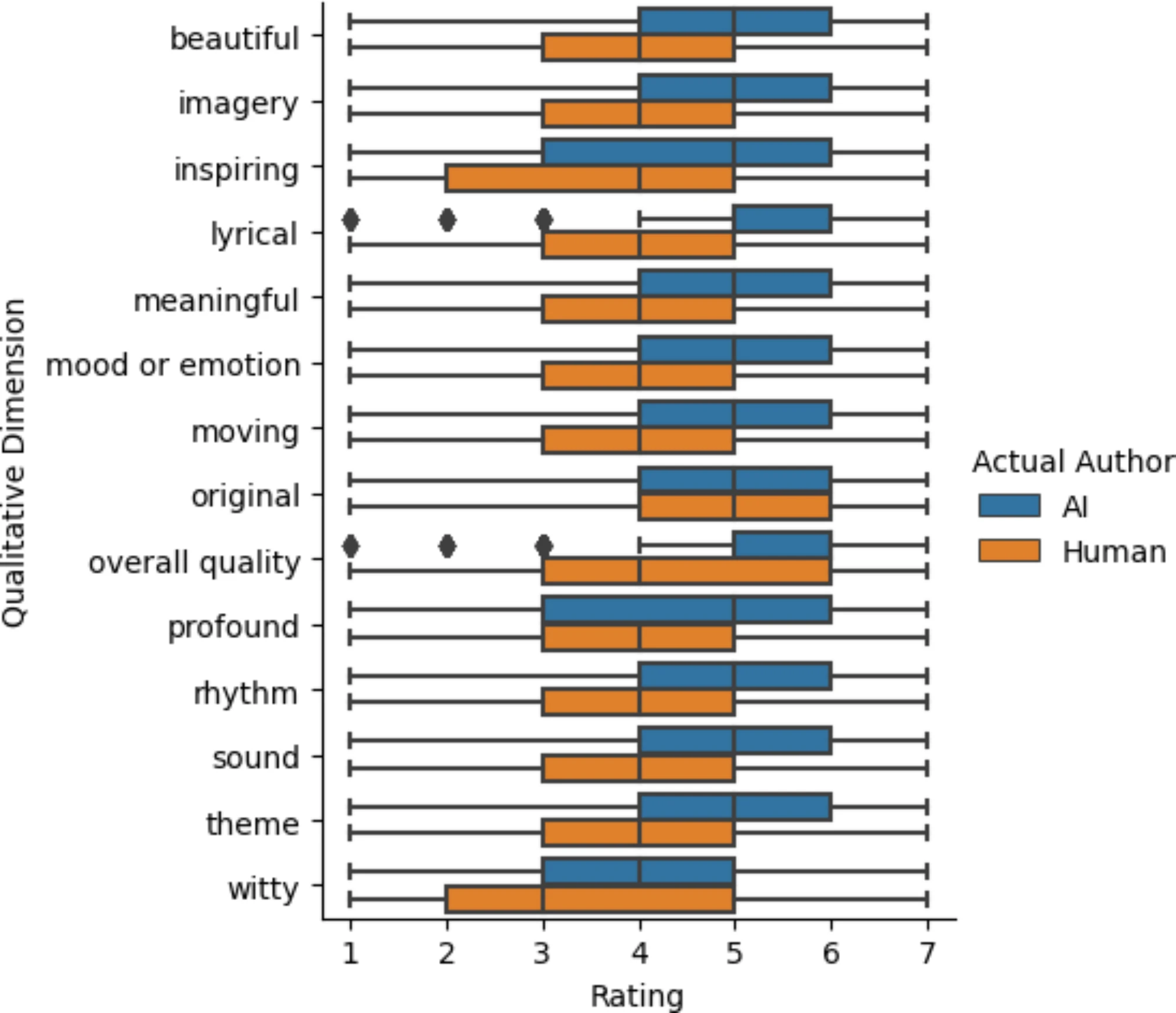
Rather than asking participants to identify the author, the researchers asked them to evaluate the poems themselves across a wide range of aesthetic dimensions, including beauty, rhythm, imagery, emotional impact, meaningfulness and overall quality. Here again, the results were striking. Across almost every category, participants preferred the AI-generated poems, consistently assigning them higher scores than poems written by canonical authors. Only originality resisted this trend; readers did not consider AI poems significantly more original, but in virtually every other respect they found them more appealing.
At first glance, this sounds like a devastating result for human literature. If ordinary readers genuinely prefer ChatGPT's poems to those of Whitman or Eliot, perhaps the machines have already won.
But that interpretation rests on a hidden assumption: that the qualities readers reward after a single encounter are the same qualities that make literature valuable over decades or centuries.
The discussion section of the paper suggests a different explanation, and it is far more persuasive. The AI-generated poems were generally easier to understand. Their emotional trajectory was clear, their imagery direct and their themes immediately recognizable, whereas the human poems often relied on historical references, layered metaphors, unusual syntax or deliberate ambiguity. Participants repeatedly described authentic poems as “not making sense,” while the AI poems communicated exactly what they wanted to communicate without asking readers to linger, reread or interpret.
That observation resonates far beyond poetry. Large language models are remarkably good at producing language that feels fluent, coherent and immediately satisfying because that is precisely what they have been optimized to do. Great literature, however, has rarely optimized for immediate satisfaction. Many of the most celebrated works in literary history derive their power from resisting interpretation, delaying comprehension or forcing the reader to participate actively in constructing meaning. Eliot is difficult because he intended to be difficult. Dickinson leaves gaps because those gaps are part of the poem. Kafka often feels opaque because clarity would fundamentally change the emotional experience of reading him.
One detail makes the study even more intriguing. Whenever participants were explicitly told that a poem had been generated by AI, they rated it significantly lower, even when the text itself remained unchanged. The label alone altered their judgement. In other words, readers simultaneously demonstrated two contradictory biases: when they did not know the author, they often preferred the AI poems, but once they were informed that the author was a machine, they immediately became more critical.
There is also an important historical footnote that deserves more attention than it has received. Every poem in the experiment was generated by ChatGPT 3.5, a model that now belongs to what feels like a previous geological era of artificial intelligence. GPT-3.5 was released in late 2022, and while it represented a remarkable breakthrough at the time, it has since been surpassed by several generations of models that possess dramatically stronger reasoning abilities, much larger context windows and a far more sophisticated command of style and tone. If ordinary readers were already unable to distinguish GPT-3.5 from celebrated poets, it is difficult to imagine that repeating exactly the same experiment today with a modern frontier model would make the task any easier. Whether the results would be identical is an empirical question, but it seems unlikely that the newer models would perform worse than the one used in the study.
For us, this is where the paper becomes directly relevant to literary translation. One of the greatest strengths of modern language models is their ability to produce prose that reads effortlessly, smoothing awkward constructions, clarifying ambiguous passages and resolving stylistic tension almost instinctively. Those capabilities are enormously valuable, but they also create a subtle risk. Literature is full of passages that are intentionally awkward, ambiguous or resistant because those qualities are part of the author's artistic intention. A translation that automatically removes every rough edge may become easier to read while becoming less faithful to the original work.
Perhaps that is the real lesson hidden inside this study. The fact that AI can produce poetry that many readers enjoy is undeniably impressive. The more difficult question is whether immediate readability should be the metric by which we judge literature at all. If we begin to reward every text for being transparent, emotionally explicit and frictionless, we may gradually teach our models, and eventually ourselves, to iron out precisely those features that have made literature worth returning to for centuries.