The Martian
"The Martian" Had One Advantage You Probably Don’t
Andy Weir could test his novel directly in the world’s largest literary market. For writers outside English, translation has always been the gate before the gate.

There is a wonderful publishing story about a man who leaves an astronaut alone on Mars and, in the process, accidentally rescues himself from obscurity.
Andy Weir began publishing The Martian chapter by chapter on his website, for free, after having little luck with literary agents on earlier work. Readers came, not millions of them at first, but that small and precious tribe every unknown writer dreams about: people who actually wanted the next chapter and were willing to come back for it.
Some of those readers eventually asked for a Kindle version because reading a novel on a website was a nuisance, so Weir obliged and put it on Amazon for 99 cents. The book started selling, then started selling rather well, and within three months it had moved around 35,000 copies. Eventually the strange machinery of traditional publishing, which had previously shown little interest in him, began moving in the opposite direction: Crown Publishing bought the print rights, and the book was commercially published in 2014.
From there, things became almost indecently successful. The Martian became a #1 New York Times bestseller; Ridley Scott directed the film adaptation, Matt Damon played Mark Watney, and the movie arrived in cinemas in October 2015.
It is one of the great self-publishing stories, and writers like to tell it because it contains everything we need to keep ourselves alive at three in the morning: rejection, stubbornness, readers discovering something without being told to discover it, and finally the enormous publishing industry arriving late to the party with a contract in its hand.
But there is one detail in the story that is so obvious we rarely mention it: Andy Weir writes in English.
That doesn’t explain why The Martian succeeded, of course. The book succeeded because people loved it, and the English language contains warehouses full of unsuccessful novels, so being a native English speaker is clearly not a publishing strategy. What it gave Weir, however, was something extraordinarily valuable: he could test his novel directly in the largest international literary marketplace without first having to cross a language barrier.
And that changes the story.
The gate before the gate
Imagine the same writer somewhere in Italy, France, Spain or Germany. He has written a good novel, perhaps a very good one, but his local publisher doesn’t want it, or he has self-published it and found a few thousand readers, or he has sent it to enough literary agents to develop an intimate relationship with rejection emails. Eventually he thinks: fine, let’s try English.
And immediately he discovers another problem, because before an English-speaking reader can decide whether his novel is worth reading, the novel has to become English.
The current Penguin Random House paperback of The Martian runs to 416 pages, while the ebook is listed at 400. For a professional literary translation, a manuscript of that size is not a small experiment but a serious investment, made before you have the slightest evidence that anybody in the target market wants the book at all.
This creates a peculiar asymmetry in self-publishing. An English-language novelist can write a book, put it online, lower the price, give away chapters, experiment with covers and descriptions, run advertisements, send copies to reviewers and generally make a fool of himself in public until something works. A novelist writing in another language can do exactly the same thing at home, but the moment he wants to test the English market, he discovers that admission to the casino can cost thousands.
For an established publisher, this is simply an investment decision involving editors, budgets, foreign-rights departments and sales projections. For an independent novelist sitting at a kitchen table with a finished manuscript and a cup of coffee that went cold forty minutes ago, it is something rather different.
It is a wall.
Literary agents cannot reject a book they cannot read
This is where the romantic story of self-publishing becomes less romantic, because although we often say that digital publishing removed the gatekeepers, what it really did was remove some of them. Nobody needs permission to publish a Kindle book or build a website and start releasing chapters, but language itself remains a gatekeeper, and a remarkably efficient one.
If your novel is written in Italian and you want to discover whether American readers might like it, you cannot simply repeat Andy Weir’s experiment. You cannot put the Italian manuscript on Amazon US, wait six months and conclude from the silence that Americans are strangely indifferent to your masterpiece about a divorced taxidermist in Turin.
First you need an English book.
The same problem appears when approaching English-language literary agents. A synopsis can be translated cheaply and a sample can be translated beautifully, but sooner or later somebody needs the manuscript, and when that manuscript contains 80,000 or 100,000 words, the economics become uncomfortable very quickly.
Traditional publishing therefore has a language gate before its famous editorial gate. For native English writers that first gate is almost invisible; for everyone else, it can be the most expensive one.
And then came the machines
This is where AI translation becomes interesting to us, and not because we believe literary translators should disappear into a puff of GPU smoke. What interests us much more is the way AI changes risk.
Until recently, translating an entire novel into English was something you normally did after somebody had decided that the book had commercial potential: a publisher acquired foreign rights, commissioned a translator, edited the translation and released the book. For an independent author, reversing that order was financially painful because the large expense came before the market test.
AI changes the economics enough that the order itself can change.
An author can translate the whole manuscript, work through it carefully, revise problematic passages, compare alternatives, correct voice and terminology, and produce an English edition good enough to put in front of actual readers without first spending a small fortune merely to discover whether those readers exist.
And this is an important distinction, because the first translation does not necessarily have to be the translation carved into marble for the next hundred years. It can also be a market probe, a relatively inexpensive way of asking a very expensive question:
Does this book travel?
Perhaps fifty people buy it and nothing happens, in which case the experiment has given you an answer. Perhaps five hundred people buy it and reviews begin appearing; perhaps one reviewer sends it to somebody else, an agent reads it, or nothing happens for six months and then, for reasons nobody will ever completely understand, something does.
This is more or less how publishing has always worked. The difference is that writers working outside English have traditionally needed considerably more money just to buy a ticket.
The point isn’t to manufacture another Martian
There is a dangerous lesson to take from Andy Weir’s story, which is that if you self-publish your novel for 99 cents, Ridley Scott will eventually telephone. He probably won’t, and if that is your business plan you may want to keep your day job a little longer.
The useful lesson is less spectacular and much more interesting: Weir was able to expose his work directly to readers, and those readers produced the signal that the publishing industry eventually noticed. The audience came before the big publishing deal, not after it, which meant that his book had the opportunity to prove itself in the market rather than waiting for somebody inside the industry to predict whether a market existed.
For a writer working in a language with five million, twenty million or sixty million speakers, AI translation creates the possibility of running a similar experiment in a language spoken and read by hundreds of millions. It does not make the experiment successful, it does not guarantee discovery and it certainly does not persuade Matt Damon to spend two hours growing potatoes on Mars for you, but it makes the experiment possible.
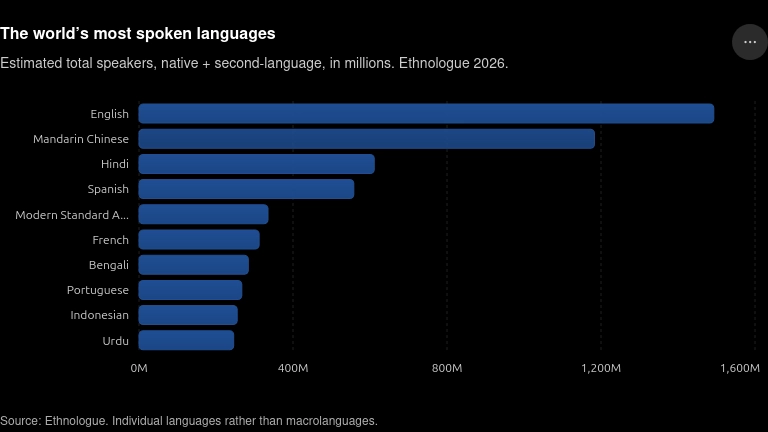
That may turn out to matter much more than all the grand predictions about AI replacing translators or writing novels by itself. The quieter revolution is simply that a novelist who has already been told no can afford to ask a much larger group of readers the question directly.
For decades, a writer outside the English-speaking world could look at the English market through the window and think, I’d like to see what happens over there, only to sit down, calculate the cost of translating 400 pages, and quietly close the window again.
Now the arithmetic is changing.
Andy Weir was lucky enough to be writing in their language. The rest of us are getting machines.