The Book Is Yours. The Translation Should Be Too.
The Book Is Yours. The Translation Should Be Too.
AI has made book translation cheaper and faster—but authors should ask who owns, controls, and can revise the translated edition when the machine finishes.
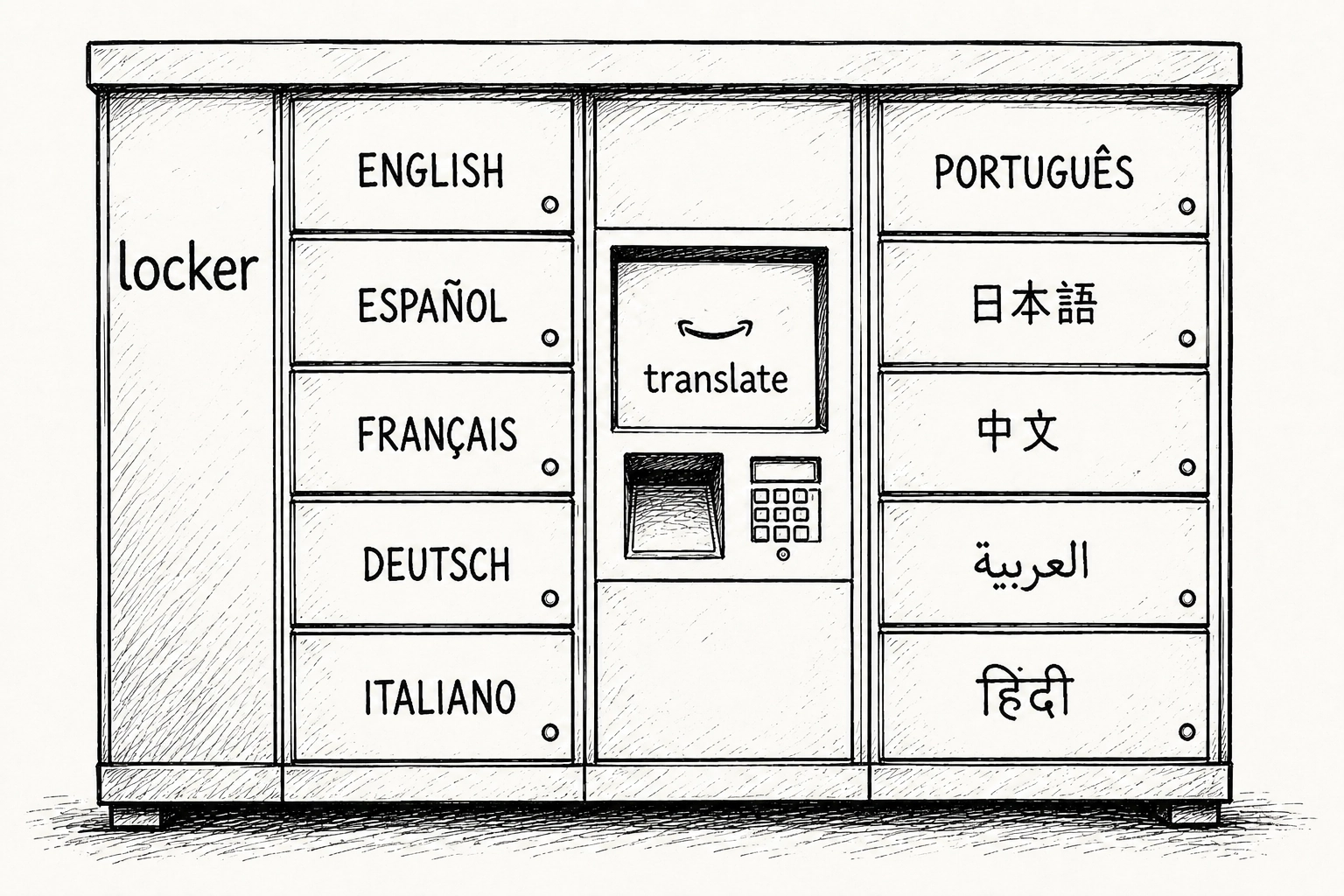
There was a time when getting a novel translated required a publisher, a contract, a translator, an editor, some money and quite a lot of patience. For the independent writer, especially one working outside English, this often meant that the door to another market was not exactly closed, but it had a large man standing in front of it asking to see your bank account.
Artificial intelligence has changed that arithmetic.
Translation is becoming dramatically cheaper and faster, and this matters because the book market itself is already being transformed by the same economics. A recent paper by Tuhin Chakrabarty, Xinyue Liu, Jane C. Ginsburg and Paramveer Dhillon examined 14,419 self-published genre-fiction ebooks sold on Amazon between 2023 and 2026. Their conclusion is uncomfortable and fascinating: generative AI does not need to produce better books to change the market. It can change the market simply by producing more books.
That distinction matters.
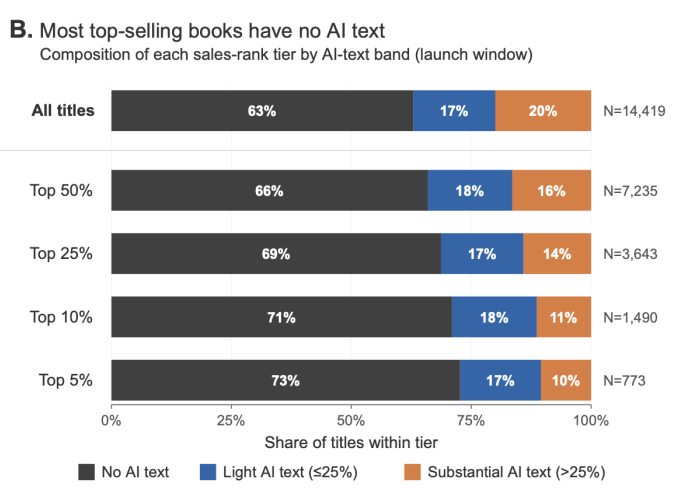
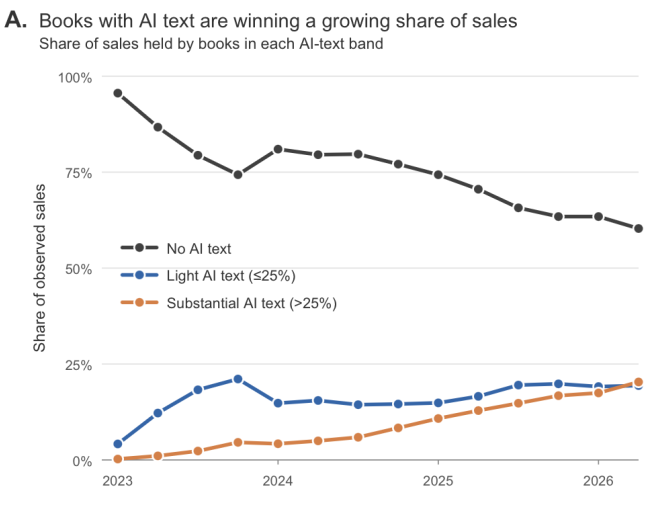
The researchers found that books containing substantial amounts of detected AI text represented 20% of their sample, but only 12.1% of sales and 11.3% of revenue. Human-written books still performed considerably better. Yet the AI books were multiplying so quickly that their individual mediocrity did not matter very much. Some reached the top of the rankings, and their share of observed sales rose from almost nothing in early 2023 to roughly 20% by the second quarter of 2026.
The machine does not have to write East of Eden. It can arrive with ten thousand books while you are still arguing with Chapter Seven.
And that is where things get interesting for translation.
AI has created a new translation economy
For authors, the important consequence of AI is not that everyone should start generating novels by pressing a button. The more interesting consequence is that something historically expensive has suddenly become accessible: the internationalization of an existing book.
A novelist sitting in Naples, Lyon, Warsaw or Buenos Aires no longer has to regard the English-language market as distant territory simply because translating a 400-page novel professionally might cost thousands of euros. The economics are changing underneath our feet.
And Amazon has noticed.
Amazon Kindle Translate is currently an invitation-only beta that allows eligible KDP authors to generate AI translations of their ebooks. The service is free during the beta, and authors can preview the resulting translation before publishing it. Amazon currently supports translation from English into French, German, Italian, Brazilian Portuguese and Spanish, while those languages can be translated into US English.
For an independent author, the proposition is wonderfully seductive.
Your book is already on KDP. Click a button. Choose Spanish. Wait a few hours. Voilà: Madrid.
There is only one problem.
Read the terms.
Amazon will translate your book. But it will not give you the translation.
This is the part authors should understand before clicking anything.
Under the current Kindle Translate beta terms, Amazon retains ownership of the Kindle Translate Edition files. You cannot take that Kindle Translate edition and distribute it somewhere else. The printing and distribution rights granted to Amazon for those editions remain exclusive to Amazon parties.
There is an important nuance here. Amazon does not prevent you from commissioning or creating a different translation of the same book in the same language and selling that elsewhere, unless other exclusivity provisions such as KDP Select apply. But the translation produced through Kindle Translate itself stays inside Amazon's garden.
That is a rather extraordinary exchange when you think about it.
You bring the novel.
You bring the characters, the plot, the voice, the years spent writing it and, crucially, the translation rights Amazon requires you to possess in the first place.
Amazon brings the machine.
And the resulting Kindle Translate edition cannot leave Amazon.
There is another limitation that may matter even more to literary authors: you currently cannot directly edit the translated text. You can preview the translation before publication, but direct editing is not available.
Amazon does run translations through an automated seven-step quality-assurance process covering mistranslations, idioms, terminology, forms of address, gender consistency, grammar, spelling and other literary elements. That is useful quality control. But it is not the same thing as putting the translation into the hands of someone who can argue with a sentence.
And books are full of sentences worth arguing about.
Translation is not a checkbox
This is where the distinction between AI translation and AI-assisted translation becomes important.
A literary translator does considerably more than determine what a sentence means. There is rhythm, register, repetition, characterization, historical context, jokes, ambiguity and those peculiar little decisions an author makes that look accidental until somebody “corrects” them.
AI can now perform an astonishing amount of the first-pass work. Pretending otherwise is not going to protect the translation profession. The economics have already moved.
But precisely because AI has made translation cheap, authors have a new possibility: use the machine for what it does extraordinarily well, while keeping humans in the places where judgment matters.
The result can be an entirely different economic model from traditional literary translation. Instead of paying someone to translate hundreds of pages from scratch, AI can generate the working translation and human expertise can be concentrated on revision, difficult passages, stylistic consistency and final validation.
Most importantly, the author can retain control of the resulting translation.
That distinction becomes increasingly important in the market described by Chakrabarty and colleagues. Their study found that between 2023 and 2026 the number of selling titles grew 19.2-fold while quarterly revenue grew only 8.9-fold. There were vastly more books chasing a pool of reader attention that was growing much more slowly.
The authors call the phenomenon dilution. AI makes production so cheap that volume itself becomes a competitive force. Their broader conclusion is particularly striking: generative AI can reshape a creative market through scale rather than quality.
For independent authors, there is a lesson hiding inside those numbers.
If the market is becoming larger, faster and more crowded, then reaching readers in several languages may become increasingly valuable. But surrendering control over those translations to the same platform that already controls much of your distribution seems an unnecessarily expensive way to obtain something advertised as free.
Free translation has a price
Amazon's offer is not sinister. In fact, Kindle Translate is evidence of something genuinely exciting: AI translation has crossed the threshold from experiment to publishing infrastructure.
The question is no longer whether machines can translate books. Guess what? They can.
The more useful question for authors is who controls the translation after the machine has finished.
If you translate your novel into English, Spanish, French or German, that new edition can become an asset in its own right. You may want to publish it on several stores, sell it directly, submit it to foreign publishers, produce a print edition, create an audiobook, license territorial rights or revise the translation five years from now when the technology has improved.
A translation should therefore be treated much like the manuscript from which it came: something worth owning, editing and carrying with you.
The cheapest translation is not necessarily the one that costs zero dollars today.
Sometimes the expensive part comes later, when you discover that the door was free because somebody else kept the key.